

Resources
The Belief Cycle
Understanding how beliefs shape perception, emotional responses, behaviour and the experiences we create within ourselves, our relationships and our environments.
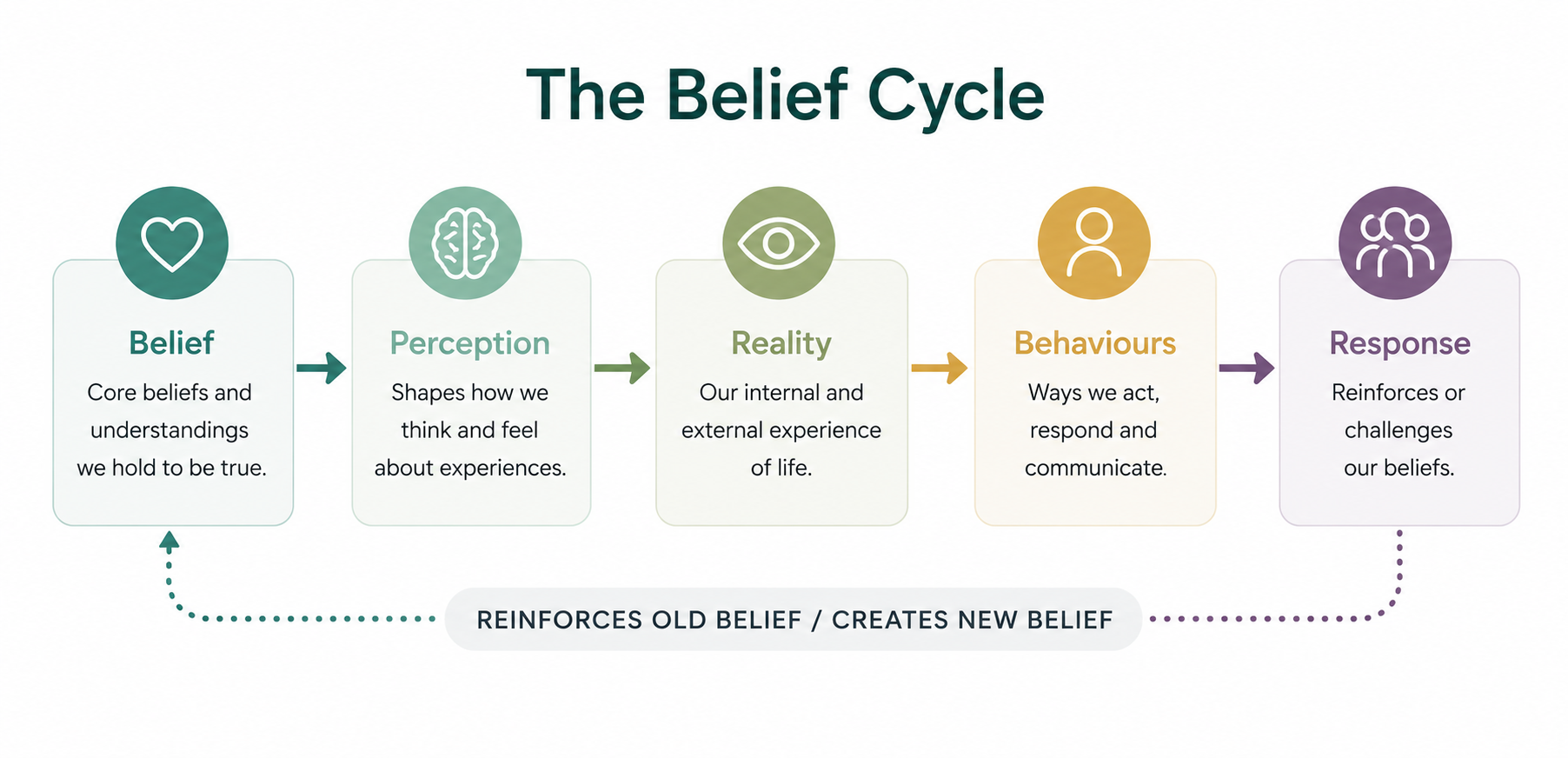
Understanding the Belief Cycle
The Belief Cycle explores how our beliefs influence the way we think, feel, behave and experience the world around us.
Much of this process happens unconsciously.
We often move through life believing our reactions, emotions and experiences are simply ‘who we are’ or ‘reality’, without realising how deeply our beliefs are shaping the lens through which we experience life.
Here we walk you through the Belief Cycle using self-limiting beliefs as an example. However, this same cycle can also be used intentionally to create healthier, more balanced and empowering beliefs.
Core Beliefs
Core beliefs are the deep understandings we accept as true about ourselves, others and the world around us.
They become part of our identity — often so ingrained that we no longer question them.
These beliefs sit beneath our conscious awareness. When something happens in our environment, our mind instinctively searches for the belief that feels most familiar and safest in order to help us respond and protect ourselves.
This is what often triggers our reactions, emotional responses and behaviours.
Our beliefs are shaped through:
childhood experiences
relationships
repeated emotional experiences
stress and trauma
environments
culture
whakapapa (ancestral patterns and experiences)
Each belief carries its own associated thoughts, emotions and behavioural tendencies which begin shaping the way we perceive situations.
[Explore The Spectrum of Belief →]
Perception
Our perception is the unconscious lens through which we view ourselves, others and the world around us.
Two people can experience the exact same situation very differently depending on the beliefs influencing their perception.
When beliefs combine with our thoughts and emotional responses, they begin shaping the meaning we give to experiences.
Over time, this perception starts forming what feels like our reality.
Reality
Our reality feels very real to us.
It influences:
emotional wellbeing
stress responses
the nervous system
the physical body
relationships
sense of belonging
the environments we create around us
How often have you:
felt physically sick or anxious over a situation?
replayed something repeatedly in your mind?
felt like you didn’t belong?
emotionally reacted to something long after it happened?
These experiences are real — but they are often influenced by the beliefs, thoughts and emotions shaping the way we interpret situations.
Sometimes what we experience as “reality” is actually our nervous system, emotions and perception reinforcing a story created through narrowed or self-limiting beliefs.
Behaviours
Our behaviours are often reactions to the reality we believe we are experiencing.
Have you ever:
been triggered by something unexpectedly?
reacted in a way that surprised you?
later reflected and wondered why you responded that way?
This is often the Belief Cycle operating unconsciously.
The way we think, feel and interpret situations influences:
how we communicate
how we respond to stress
how we relate to others
the behaviours we display within our environments
Behaviour is often the outward expression of deeper emotional patterns and beliefs.
[Explore Understanding the Behaviour Flow]
Responses and Reinforcement
The responses we attract from others often reinforce the beliefs we already hold.
For example:
fear-based behaviours may attract defensive responses
withdrawal may reinforce feelings of isolation
people-pleasing may reinforce feelings of unworthiness
anger may attract conflict
And so the cycle continues.
Over time, these repeated responses strengthen the belief that created the behaviour in the first place.
However, every so often we experience a response rooted in understanding, compassion or genuine connection.
These moments can be powerful.
Sometimes a single person believing in us, understanding us or responding differently can help us begin seeing ourselves and our experiences through a completely new lens.
This is often where new beliefs begin forming.
Creating New Beliefs
Developing a resilient mindset is an important part of emotional wellbeing, relational wellbeing and personal growth.
As we become more aware of our belief patterns, we create the opportunity to consciously respond differently rather than reacting unconsciously.
Through awareness, reflection, compassion and intentional practice, people are often able to:
challenge self-limiting beliefs
strengthen balanced beliefs
create healthier behavioural patterns
improve relationships
support nervous system regulation
create healthier environments for themselves and others
Over time, these new ways of thinking, responding and relating begin reinforcing new beliefs within the subconscious mind.
The more awareness we bring to the cycle, the more consciously we begin shaping the way we think, respond, relate and influence the environments around us.
Beyond the Individual
The Belief Cycle does not only influence individuals.
Beliefs, behaviours and emotional patterns also influence:
whānau
teams
kura
organisations
communities
wider environments
Over time, collective beliefs and behaviours begin shaping the culture and relational environments people experience together.
This understanding forms part of broader frameworks such as:
The Behaviour Flow
The Spectrum of Belief
Relational Wellbeing
Understanding Stress, Mindset and the Nervous System
Reflection and Awareness
What beliefs most influence the way I see myself, others and the world around me?
How do my beliefs shape the way I respond to stress, challenge or conflict?
What emotional patterns or behaviours do I notice repeating within my relationships and environments?
What environments reinforce the beliefs I currently hold?
What beliefs may no longer support my wellbeing, relationships or growth?
What new beliefs would support healthier ways of thinking, relating and responding?